
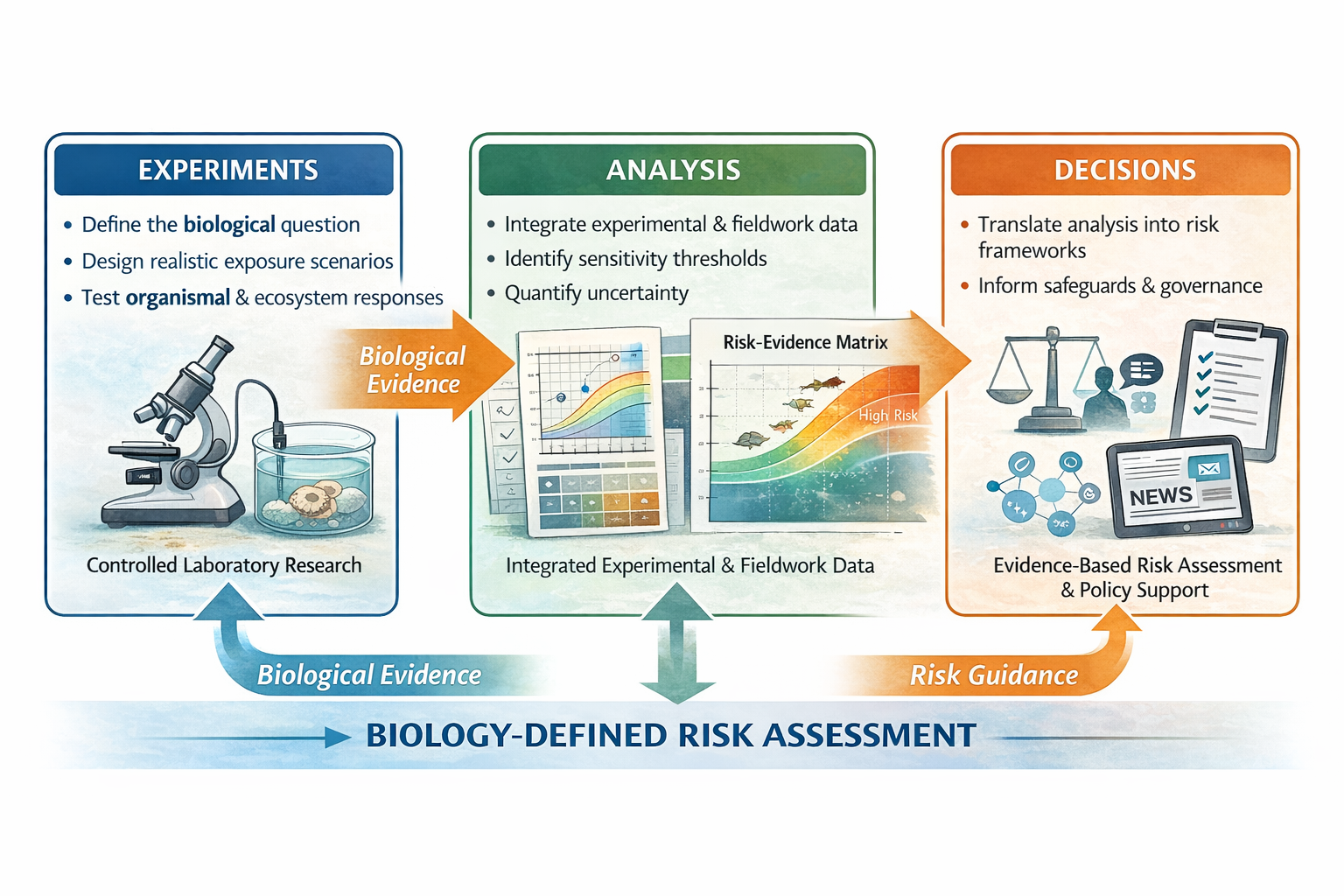
Approach: A Biological Risk Framework
My approach is grounded in a central principle: biology defines the limits of mCDR, specifically OAE. If biological responses are not explicitly evaluated, environmental risk cannot be responsibly assessed. Rather than assuming technical feasibility, I begin by identifying the biological processes and sensitivities that constrain what climate interventions can safely achieve.
A Structured Biological Decision Framework
- Define the Biological Question and Establish Exposure Realism
Each intervention is first translated into a biological problem: Which organisms, life stages, and ecological processes are most likely to be affected by changes in seawater chemistry? This step ensures that biological relevance guides study design from the outset.
Exposure scenarios are framed around real ocean conditions, including natural variability in carbonate chemistry dynamics and realistic intervention pathways. This prevents over- or under-estimating biological sensitivity by anchoring analysis in environmental context.
- Quantify Sensitivity and Uncertainty
Biological responses are evaluated using sensitive physiological and ecological indicators across species and life stages. Uncertainty is treated explicitly by comparing responses across exposure histories, taxa, and environmental regimes. This step links organismal biology with comparative vulnerability analysis.
- Translate Biology into Risk Metrics and Integrate Biology into Decision Framework
Observed responses are converted into risk-relevant metrics that allow biological evidence to be incorporated into monitoring strategies, modelling frameworks, and precautionary assessments. They include:
- biological thresholds
- vulnerability indices
- early-warning stress indicators
- exposure–response relationships
The final step connects biological evidence to the needs of climate intervention planning, ensuring that biological limits are visible in discussions of feasibility, scalability, and safety.
This integration ensures that ecosystem responses are treated as constraints, not side effects, of climate intervention strategies. By embedding biological evidence within a structured risk framework, this prevents or reduced unintended ecological harm, improves interpretation of experimental and field data and supports precautionary approach of emerging climate interventions.

